I’ve refunded more local SEO tools than I’ve kept. Most of them do the same twelve things, charge per location, and haven’t updated their UI since Obama was president.
The affiliate-bait listicles ranking for “best local SEO tools” are useless. Written by people who’ve never run a local campaign, just regurgitating feature lists and collecting their 15%.
So here’s the version from someone who’s used this stuff.
Why You Even Need Local SEO Tools
90% of local SEO is keeping your shit consistent.
Your business name, address, and phone number (the famous NAP) needs to be identical everywhere. One listing says “123 Main St” and another says “123 Main Street”? Google gets confused. Confused Google means you don’t show up in the Map Pack.
You also need to know where you rank. Not where YOU see yourself ranking when you search on your phone (Google personalizes that). Where customers see you.
And reviews. You need to monitor reviews, respond to them, and ideally generate more of them without looking like you’re begging.
That’s basically it. Everything else is nice-to-have.
So local SEO tools exist to automate these three core jobs: citation management, rank tracking, and review management.
The question is: which ones are worth paying for?
The Three Tool Categories That Matter
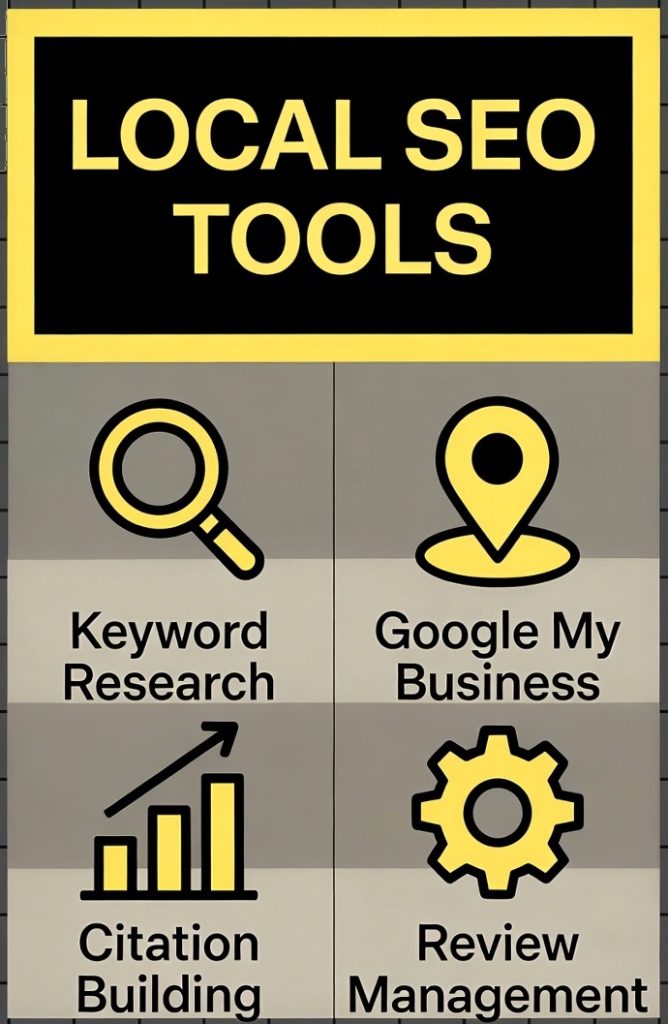
Before we get into specific tools, understand there are four distinct categories of local SEO tools.
Keyword Research helps you understand what phrases people are using to find your business or searching for problems your business helps solve.
Google Business Profile Management Tools help you optimize and manage your GBP listing (formerly Google My Business). Posts, Q&A, attributes, photos, all that stuff that Google wants you to update constantly.
Citation & Listing Management tools distribute your business info across directories like Yelp, Apple Maps, Bing Places, and the 847 other directories you’ve never heard of. They also scan for inconsistencies and duplicates.
Rank Tracking & Reporting tools show you where your business appears in the Local Pack and organic results. Most important: they track from SPECIFIC locations, not just “somewhere in your city.”
Some platforms try to do all three. Most do one thing well and the rest mediocrely.
BrightLocal: The Default Choice
What it does: Citation building, rank tracking, review monitoring, GBP audits, white-label reports
Pricing: Starts at $39/month per location, scales up quickly
BrightLocal is the most popular local SEO platform because it does everything competently. Not amazing at anything, but good enough at most things.
The citation tracker works. The rank tracker is solid. The reporting looks professional if you’re an agency. The interface doesn’t make you want to throw your laptop.
The downside? It’s expensive once you’re managing multiple locations. $39/month for one location is fine. $400/month for 10 locations adds up fast. And a lot of features feel like they were built in 2016 and haven’t been updated since.
Use it if: You’re an agency managing multiple clients and need decent reporting. You want one platform that covers most bases.
Skip it if: You’re managing just your own single location business. The pricing doesn’t make sense for solo work.
Google Business Profile is Free, So Use It
What it does: Manages your Google listing, monitors performance, shows search insights
Pricing: Free
Obviously you need to claim and optimize your GBP. That’s not even a question.
The built-in insights are weak. Google only shows you 6 months of data and thresholds anything under 15 searches. But the API connection to Looker Studio? That’s useful. You get 18 months of data and all your search queries, not just the ones Google decides to show you.
Set that up. It takes 20 minutes and it’s the single best piece of free data you’ll get.
Use it if: You exist as a local business. This isn’t optional.
Skip it if: You don’t have a physical location or service area business.
Local Falcon: Fast Rank Checks Without the Bullshit
What it does: Grid-based rank tracking for Google Maps
Pricing: Plans start around $20-30/month
Local Falcon does one thing really well: it shows you exactly where you rank in the Map Pack across a geographic grid.
You pick your location, set up a grid (maybe 25 points across your city), enter your keywords, and boom. Heatmap showing where you’re visible and where you’re invisible.
The Share of Local Voice (SoLV) metric is legitimately useful. It calculates how often you appear in the top 3 Map Pack positions across your entire grid. Most rank trackers just tell you if you’re #1 or #8 from ONE location. SoLV tells you your market dominance.
Reports generate in a few minutes, which is fast compared to most rank trackers that make you wait hours.
Use it if: You need quick local ranking data and want visual heatmaps. Great for diagnosing why you’re not showing up in certain neighborhoods.
Skip it if: You’re only tracking 2-3 keywords. The grid approach is overkill for minimal tracking needs.
Places Scout: When You Need the Most Accurate Data
What it does: Advanced local and organic rank tracking with SERP screenshots
Pricing: Not cheap (you’ll pay for the accuracy)
Places Scout is the most accurate local rank tracker I’ve used. It handles both Map Pack rankings and organic rankings on the same grid, which matters more than most people realize.
Why? Because local rankings and organic rankings interact. You might rank #1 in Maps but #15 in organic. Or vice versa. Google’s local pack boundaries affect organic results too. Places Scout shows you all of it.
The SERP screenshot feature is clutch for diagnosing ranking changes. Instead of guessing why you dropped, you can literally see what the SERP looked like on that day.
Use it if: You’re serious about local SEO and need the best data available. You’re managing competitive markets where accurate tracking matters.
Skip it if: Budget is tight and you’re just starting out. Cheaper tools will get you 80% of the way there.
Whitespark: Citation Finding, Not Building
What it does: Citation finder, rank tracking, reputation builder
Pricing: Modular pricing, tools sold separately (roughly $20-60/month per tool)
Whitespark’s citation finder is legitimately useful. You enter your competitors’ URLs and it shows you where they’re listed. Then you can go get listed there too.
That’s it. That’s the tool. It doesn’t automatically build the citations for you (they offer that as a separate manual service for $20-100 per campaign). It just tells you where to go.
The rank tracker is fine. Nothing special. The reputation builder is… also fine.
The unbundled pricing is annoying. Want to use the citation finder AND the rank tracker? Two separate subscriptions. Most people end up spending more than they would on an all-in-one platform.
Use it if: You’re in a competitive local market and need to find citation opportunities your competitors are using.
Skip it if: You’re not in a super competitive market. Most citation opportunities are obvious (Yelp, Facebook, industry directories).
Semrush Local: Useful If You Already Have Semrush
What it does: Listing distribution via Yext network, basic rank tracking, review management
Pricing: Add-on to base Semrush subscription (starts around $40-50/month per location on top of Semrush base)
Semrush Local is powered by Yext’s network. It works. Your listings get distributed to supported directories through API connections.
The main advantage is keeping everything in one ecosystem if you already use Semrush for broader SEO work. The main disadvantage is you’re paying for both Semrush AND the local add-on, which gets expensive fast.
The rank tracking is basic compared to dedicated local rank trackers. The heatmap tool exists but isn’t as robust as Local Falcon or Places Scout.
Use it if: You already pay for Semrush and want to consolidate tools. You manage 5+ locations and the Yext network makes sense.
Skip it if: You don’t already use Semrush. Starting a Semrush subscription just for local tools is overkill.
Ahrefs: Not a Local Tool, But Use It Anyway
What it does: Keyword research, backlink analysis, SERP analysis
Pricing: Starts at $129/month
Ahrefs isn’t a local SEO tool. But you need it anyway.
Why? Because local SEO still requires keyword research. You need to know what people are searching for. “Plumber in Chicago” gets 1,000 searches/month. “Emergency plumber Chicago” gets 800. “Chicago plumbing repair” gets 400. Those are different intents and different opportunities.
Ahrefs Keyword Explorer shows you this data. It doesn’t drill down to city-level volume (you only get country-level), but it’s close enough to make strategic decisions.
The backlink data matters for local too. Your local competitors have backlinks. You should see where they’re getting them.
Use it if: You’re doing any serious SEO work, local or otherwise. The data justifies the cost.
Skip it if: You’re literally just managing a GBP listing and nothing else. You don’t need Ahrefs for that.
The Free Tools You Should Use
Google Analytics 4: Yes it’s confusing. Yes you need it. Connect your GBP Insights to Looker Studio via the API to get better data.
Google Search Console: Shows which keywords are driving impressions and clicks to your site. Free data is free data.
BrightLocal’s Free Tools: They offer free rank checkers and review link generators. Use them.
Answer The Public/AlsoAsked: Find question-based keywords for content creation. People search “how to” and “what is” queries for local services too.
What About Yext, Moz Local, and the Enterprise Tools?
Yext: Expensive. We’re talking $500+ per location per year minimum. Great if you’re a franchise with 100+ locations. Overkill for small businesses.
Moz Local: Cheapest option at $14/month per location, but extremely limited. Good for basic NAP management. Not much else.
Rio SEO, Advice Local, SOCi: Enterprise platforms designed for big retail brands. If you have to ask the price, they’re not for you.
The Honest Tool Stack for Different Scenarios
Single Location Local Business: Google Business Profile (free) + Looker Studio API connection, Local Falcon ($20-30/month) for rank tracking, manual citation building on major directories (free). Total cost: $20-30/month.
Local Agency Managing 5-10 Clients: BrightLocal ($200-400/month depending on locations), Ahrefs ($129/month) for keyword research. Consider adding Whitespark Citation Finder ($30-60/month) for competitive markets. Total cost: $350-600/month.
Serious Local SEO Practitioner: Places Scout (varies, but budget $100+/month for accurate data), Ahrefs ($129/month), BrightLocal or build your own reporting stack. Total cost: $250-400/month.
What You Can Completely Skip
Social media management features. Most local SEO tools tack on social posting. Ignore it. If you need social management, get a dedicated tool. The features in local SEO platforms are always half-assed.
AI review response tools. These are starting to appear everywhere. The AI-generated responses sound like AI-generated responses. Write your own or hire someone. Don’t let robots talk to your customers.
Automatic citation building to 300 directories. You don’t need to be listed on 300 directories. You need to be listed on the 15-20 that matter for your industry and location. Quality over quantity.
“SEO audits” bundled in local tools. Most of these are basic crawls that check for obvious issues. If you need a real technical SEO audit, use Screaming Frog or Sitebulb. The audits in local platforms are marketing features, not diagnostic tools.
The Questions Nobody Asked Me (But Should)
“Do I need paid tools?”
For a single location with basic needs? No. GBP plus manual work gets you 80% of the results.
For multiple locations, competitive markets, or agency work? Yes. The time saved on reporting and monitoring alone justifies the cost.
“Why is local SEO software so expensive?”
Because most local SEO tools charge per location. One business = $39/month. Ten locations = $400+/month. The costs scale fast.
Some newer tools (like Localo, GBP Promote) are trying to break this model with flat pricing, but they’re not as feature-rich yet.
“Can I just do everything manually?”
Sure. You can manually check rankings, manually build citations, manually monitor reviews. It takes 5-10 hours per week per location.
Tools don’t do the work FOR you. They make the work faster. Whether that time savings is worth $40-100/month is up to you.
What Moves the Needle
The tools don’t rank you higher. They just help you execute faster and track what’s working.
What ranks you higher? Complete, accurate GBP profile with regular posts and updates. Consistent NAP across major directories. Reviews (quantity and quality). Relevant content on your website targeting local keywords. Local backlinks from chambers of commerce, local news, industry associations.
The tools help you manage all of that. But they’re not magic. You still have to do the work.
Most local SEO tool comparisons act like picking the right software is the hard part. It’s not. The hard part is consistently doing the boring shit that works: updating your GBP, responding to reviews, getting your NAP cleaned up, creating decent content.
Pick tools that don’t get in your way and make the boring shit less boring.
FAQ
What are the best free local SEO tools?
Google Business Profile, Google Search Console, and Google Analytics 4 are the essential free tools. BrightLocal offers free rank checkers and review link generators. AlsoAsked helps find question-based keywords. You can run a single-location business effectively using only free tools if you’re willing to do manual work.
How much do local SEO tools cost?
Single-location tools typically cost $20-40 per month. Multi-location platforms charge per location, ranging from $7-40 per location monthly. Enterprise solutions like Yext start at $500+ per location annually. Most agencies spend $300-600 monthly on local SEO tools across multiple platforms.
What’s the difference between BrightLocal and Semrush Local?
BrightLocal is a dedicated local SEO platform with comprehensive citation tracking, rank monitoring, and audit features. Semrush Local is an add-on to the main Semrush suite, powered by Yext for listing distribution. BrightLocal offers better local-specific features; Semrush Local works if you already use Semrush for general SEO.
Do I need a rank tracker for local SEO?
Yes, but how sophisticated depends on your market. Grid-based rank trackers like Local Falcon show where you rank across different locations in your service area. Basic rank trackers check from one point. Local rankings vary significantly by searcher location, so grid tracking reveals the full picture of your visibility.
Can I manage citations without paid tools?
Absolutely. The top 15-20 citations (Google, Bing, Apple Maps, Yelp, Facebook, industry directories) can be claimed and updated manually. It takes 4-6 hours of work initially, then 30 minutes quarterly for updates. Citation management tools save time but aren’t mandatory for single-location businesses.
What’s more important: rank tracking or citation management?
Citation management comes first. Clean, consistent NAP across major directories is foundational. Rank tracking helps you monitor progress and diagnose issues, but fixing incorrect citations will impact rankings more than tracking them. Get the basics right before investing in sophisticated tracking.