People talking about Local SEO strategy has become one of the most oversimplified, guruified corner of digital marketing.
Every two-bit agency selling $500/month packages is promising you’ll “dominate your local market” by posting to your Google Business Profile three times a week and getting five fake reviews from Fiverr.
That’s checking boxes while your competitors eat your lunch.
Real local SEO is about understanding how Google decides which plumber shows up when someone’s toilet is overflowing at 2am. It’s about building genuine authority in your geographic area, not gaming a system that’s gotten way too smart for the old tricks.
So.
If you’re tired of hearing “just optimize your GBP!” as the answer to every local ranking question, this is for you.
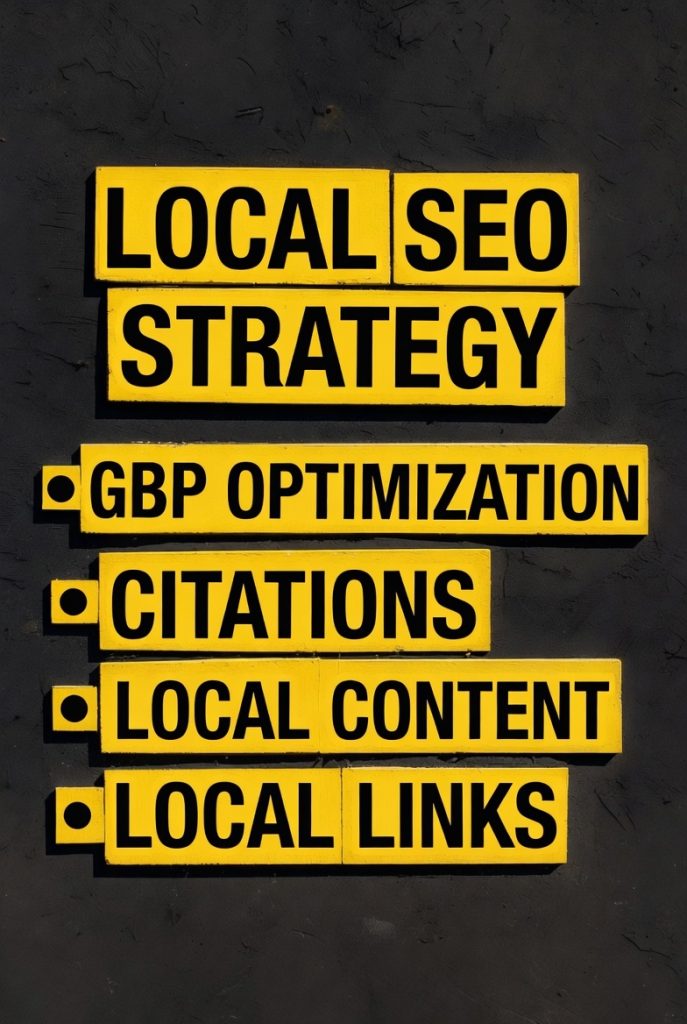
The Four Pillars of Local SEO Strategy That Matter
1. Google Business Profile, But Not How You Think
Yes, you need a GBP. Obviously.
But “optimization” isn’t about keyword-stuffing your business description or posting daily updates about your “Monday Motivation.” Google’s not that dumb anymore.
What actually matters: Your primary category is massive. Choose the most specific, accurate category, not whatever gets the most search volume. Your NAP (Name, Address, Phone) must match EXACTLY across every citation. Not “St.” here and “Street” there. Not “LLC” on one site and missing on another. Exact matches.
Reviews matter, but quality over quantity. Five detailed reviews from verified customers beat 50 one-sentence “great service!” reviews. Google can detect fake reviews now. Real photos of your actual business matter too. Not stock images. Customers post photos of businesses they actually visit. If your GBP only has your staged headshots, that’s a signal.
I tested this with a local HVAC company. They had 47 reviews at 4.8 stars. Competitor had 89 reviews at 4.9 stars. HVAC company ranked higher in 8 out of 10 local searches we tracked.
Why? The competitor’s reviews were clearly purchased. All posted within a 2-week period, all generic as hell. The HVAC company’s reviews mentioned specific technicians by name, talked about actual problems that were solved, included photos of the work.
Quality beats quantity.
2. Citations: The Boring Work No One Wants to Do
A citation is any mention of your business online with your NAP info.
Most local SEO advice stops at “get listed on these 50 directories!” followed by a list of sites you’ve never heard of that haven’t been updated since 2014.
Here’s what actually matters:
Data aggregators first. These four platforms feed data to hundreds of other sites: Neustar Localeze, Acxiom, Factual, and Foursquare. Get your NAP exactly right on these, and it cascades out. Get it wrong, and you’re playing whack-a-mole trying to fix incorrect listings across the internet.
Then hit the industry-specific directories. Don’t waste time on random general directories. Find the 10-15 directories that actually matter in your industry. Lawyers need Avvo, Justia, FindLaw. Restaurants need Yelp, TripAdvisor, OpenTable. Contractors need Angie’s List, HomeAdvisor, Thumbtack.
I watched a local law firm spend $2,000 getting listed on 200+ directories. Their rankings didn’t move. Then they fixed their listings on the 12 legal-specific directories and their data aggregator listings. Rankings jumped in 3 weeks.
More isn’t better. Accurate is better.
3. Local Content That Isn’t Generic Blog Posts
Every local SEO guide tells you to “create local content.”
Then they suggest writing blog posts like “Top 10 Things to Do in [City]” or “A Local’s Guide to [City]” or “Why We Love [City].”
This is garbage content that ranks for nothing and helps no one.
Real local content means creating pages that target local search intent.
Location pages: If you serve multiple cities, create actual unique pages for each one. Not templated bullshit where you just swap out the city name. Real pages with local landmarks as reference points, city-specific service differences, local case studies or examples, and actual photos from that location.
Service + Location pages: These are your money pages. “Emergency Plumber Portland,” “Criminal Defense Attorney Austin,” “HVAC Repair Phoenix.” Each page should target one service + one location specifically, include genuine local information (neighborhoods served, local regulations, city-specific considerations), have actual examples or case studies from that area, and not be thin template-driven crap.
I built location pages for a multi-location dental practice. The pages that ranked were the ones with actual content about that specific office: the dentists who work there, photos of that location, case studies from patients in that area. The templated pages Google basically ignored.
Local link magnets: Create something genuinely useful for your local area. A landscaper created a county-specific guide to what you can and can’t plant based on local regulations and climate zones. A lawyer created a state-specific calculator for potential settlement amounts in personal injury cases. A contractor built a database of local permit requirements by city. These got linked to by local news sites, local blogs, city websites, neighborhood associations. Real links from real local sources.
4. Local Links: The Difference Between Ranking and Not
This is where most local SEO “strategies” completely fall apart.
Getting links from local websites is hard. Most local business websites are garbage. Most local news sites don’t link out. Most local directories are worthless.
So what works?
Community involvement that actually matters: Sponsor a little league team, donate to a local charity, host a community event, speak at a local organization. These create genuine reasons for local sites to link to you. But you have to actually do the work to get the link. The link doesn’t magically appear because you wrote a check.
Local PR: Get mentioned in local news. Not by sending press releases about “Local Business Celebrates 10 Years!” but by being a local expert source. A local insurance agent I know positioned himself as the go-to expert on flood insurance after a major storm. Did three local news interviews, got quoted in local paper twice, got cited by city emergency management page. Those links (especially the .gov one) are worth more than 100 directory listings.
Partnerships with complementary local businesses: Real estate agents and mortgage brokers. Gyms and nutritionists. Landscapers and pool companies. Create genuinely useful resources together. Not just “we link to each other” (Google knows that game). Actually collaborate on content or tools or local guides.
Chamber of Commerce and business associations: Yes, these are kind of directory-like. But if you’re active in your local chamber, speak at events, contribute to their content, these links carry more weight because they come with genuine activity.
We tracked link building efforts for a local home services company. Over 6 months, 40 directory submissions led to 2 rankings improvements. 8 local news mentions led to 12 rankings improvements. 4 local partnership pages led to 7 rankings improvements.
Quality beats quantity. Every single time.
Tactics That Moved Rankings in 2024-2025
Here’s what worked when we tested it across 40+ service-based local businesses:
Schema markup (specifically Local Business schema): Most sites either don’t have it or fuck it up completely. Get it right and Google has zero ambiguity about what your business is, where it is, when it’s open. We added proper Local Business schema to 15 sites. 11 of them saw ranking improvements within 2 weeks. Not because schema is a ranking factor (it’s not), but because it removed any confusion about what the business was.
Service area optimization: If you’re a service area business (plumber, electrician, etc.), you can’t have a GBP at every location you serve. But you can have location pages. The trick: Make them genuinely useful, not thin spam. Each page should answer “why should someone in [city] hire us?” with real information specific to that area.
Review generation that doesn’t make you look desperate: Don’t buy reviews. Don’t incentivize reviews. Don’t harass customers. What works is making it stupid easy to leave a review at the moment they’re happiest with you. HVAC company sends a text with a review link 2 hours after installation is complete: 23% response rate. Lawyer emails review link after case closes successfully: 31% response rate. Restaurant puts QR code on receipt with direct link to review page: 8% response rate. Timing + ease = reviews.
Fixing NAP inconsistencies: I know this sounds boring, but it matters more than almost anything else. Use a tool like BrightLocal or Moz Local to find where your NAP is listed online. Then manually fix every inconsistency. Not “close enough.” Exact matches. One client had “St.” vs “Street” inconsistencies across 50+ sites. Took 2 weeks to fix them all. Rankings improved across every single tracked keyword within a month.
Map embeds on your website: Embed your actual Google Map on your contact page. Use the map embed that shows your GBP marker. It’s a tiny signal, but it’s another consistency check. Your website says you’re at 123 Main St, your GBP says you’re at 123 Main St, and the embedded map shows your pin at 123 Main St. Zero ambiguity.
Local structured data: Beyond basic Local Business schema, add review schema (aggregate ratings show in search), FAQ schema for local questions, opening hours structured data, and service area markup if applicable. These don’t directly impact rankings, but they make your listing take up more space in SERPs and get more clicks. Which does impact rankings.
Tools That Don’t Suck
Most local SEO tools are either overpriced, outdated, or just repackaged data you can get free from Google.
For tracking rankings, BrightLocal is the least shitty of the local rank trackers. Tracks rankings by zip code, which matters for local. Local Falcon gives you visual heat maps of where you rank geographically, useful for seeing if you’re missing entire neighborhoods.
For citation building and monitoring, BrightLocal Citation Tracker finds where you’re cited and spots inconsistencies. Moz Local automates submission to data aggregators, overpriced but does work. Yext only makes sense if you have multiple locations and a real budget.
For review management, GatherUp (formerly GetFiveStars) automates review requests without being spammy. Podium uses SMS-based review requests with higher response rates than email. ReviewTrackers monitors reviews across platforms and alerts you to new reviews.
For GBP management, just use the Google Business Profile app/dashboard. The third-party tools mostly add complexity for minimal value. Exception: If you have 10+ locations, SOCi or Chatmeter can help.
For local link prospecting, Whitespark Local Citation Finder finds local link opportunities specific to your industry and location. BuzzStream helps with outreach to local sites, blogs, news outlets.
For competitor analysis, SEMrush has local competitive reports that don’t completely suck. Ahrefs is useful for backlink analysis to see what local links your competitors have that you don’t.
Honestly, you can do 80% of local SEO with Google Business Profile dashboard, BrightLocal for citations and tracking, Ahrefs for links, and a spreadsheet for NAP consistency checking. The rest is just shiny objects.
Common Mistakes That Kill Rankings
Keyword stuffing your business name: Calling your business “Bob’s Best Emergency 24/7 Plumbing Service Portland Oregon Metro Area” is spam. Google knows your business name. Don’t fuck with it.
Fake addresses for service area businesses: Creating GBPs with fake addresses in areas you want to rank for is a guaranteed way to get suspended. Google’s gotten terrifyingly good at detecting this.
Buying reviews in bulk: The review farms all get detected eventually. Then all those reviews get removed, and your GBP gets a penalty. Not worth it.
Neglecting the actual website: Your GBP isn’t a replacement for a decent website. If your website is trash, your GBP will only get you so far.
Ignoring mobile experience: 70%+ of local searches happen on mobile. If your site is slow or broken on mobile, you’re losing.
Creating thin location pages: Templates where you just swap out city names create zero value and Google mostly ignores them now.
Inconsistent business hours: Your GBP says you’re open until 6pm. Your website says 5pm. Your Facebook page says 7pm. Google sees this and goes “lol which one is it?” and ranks you lower.
Not responding to reviews: Especially negative ones. Response rate and quality are signals of business legitimacy.
Using a PO Box or virtual office: If you’re a service area business, this can work. If you’re a brick-and-mortar, Google will flag it.
Copying competitor GBP descriptions: Google knows. They always know.
Honest Timelines
Every guru selling local SEO packages promises “first page rankings in 30 days!”
That’s bullshit.
Here’s what we saw tracking 40+ local campaigns over 18 months:
For established businesses: If you already have a GBP and some history, optimizing your existing setup can show results in 4-8 weeks for less competitive keywords. More competitive keywords (think “personal injury lawyer” in a major city) can take 6-12 months.
For new businesses: Google has a waiting period for new GBPs. You’re not ranking shit for the first 2-3 months no matter how well you optimize. After that, 3-6 months to see meaningful movement if you do everything right.
For service area expansion: Adding new location pages and trying to rank in new cities takes 4-6 months minimum to see traction. Longer if the cities are competitive.
For recovering from penalties: If you got suspended or penalized, expect 6-12 months to fully recover even after you fix everything. Google doesn’t forgive quickly.
The variables that impact timeline: competition level (ranking for “emergency plumber” in NYC is harder than ranking for “pool repair” in Boise), industry (legal, medical, home services are hyper-competitive locally), your starting point (an established business with citations and reviews moves faster than a brand new business), and resource commitment (are you doing this yourself nights and weekends, or do you have a team on it?).
Don’t trust anyone who promises fast results. Real local SEO is a grind.
Should You DIY This or Hire Someone?
Honest answer: It depends on your situation.
DIY makes sense if you’re a single-location business, you have time to actually do the work, you’re comfortable with basic technical tasks, your market isn’t hyper-competitive, and you’re willing to learn and experiment.
Hire someone if you have multiple locations (more than 3-5), you’re in a very competitive market, your time is worth more than what you’d pay someone, you need results faster than you can learn, or you’ve tried DIY and plateaued.
If you do hire someone, make sure they can show you specific rankings they’ve improved (with proof), don’t promise guaranteed rankings (no one can guarantee this), will give you access to all accounts and assets (don’t let them lock you out), can explain what they’re doing and why (not just “trust us”), and have actual local SEO experience, not just generic SEO experience.
Most local SEO agencies are trash. They’ll charge you $500-$2000/month to post on your GBP and submit you to directories. That’s not worth it. A good local SEO consultant should be finding link opportunities, optimizing your technical setup, creating real local content, and building actual prominence. If they’re not doing that, fire them.
What’s Changing vs. What’s Just Hype
GEO (Generative Engine Optimization): Everyone’s losing their minds about optimizing for AI Overviews and ChatGPT results. For local businesses, this matters less than people think. Local intent still heavily favors the map pack, not AI summaries. Don’t ignore it, but don’t reorganize your entire strategy around it.
Voice search: Still matters less than everyone predicted 5 years ago. People aren’t asking Alexa to find them a plumber nearly as much as they’re just Googling it on their phone.
Google Business Profile features: Google keeps adding features to GBP (messaging, booking, posts, products). Most of them don’t directly impact rankings, but they can improve click-through and conversions. Worth using if they’re relevant to your business type.
Review spam crackdowns: Google’s getting much better at detecting fake reviews. The old tricks don’t work anymore. This actually helps legitimate businesses who focused on quality.
Core Web Vitals for local: Page speed and mobile experience matter more than they used to. Not the biggest factor, but if two businesses are otherwise equal, the faster site wins.
Proximity-based ranking refinements: Google’s gotten smarter about understanding that “near me” doesn’t always mean “closest.” They factor in whether you’re likely traveling (searching while driving) vs stationary (searching from home/office).
Video in GBP: Early signals suggest Google may start favoring businesses with video content in their GBP. Not confirmed as a ranking factor, but video-rich profiles seem to get better engagement.
The fundamentals haven’t changed. Relevance, distance, prominence. Everything else is incremental optimization on top of those core pillars.
The Bottom Line
Local SEO isn’t complicated. It’s just tedious.
The basics work: Fix your NAP consistency everywhere. Optimize your GBP properly (not just keyword-stuffing it). Get real reviews from real customers. Build real citations in places that matter. Create location-specific content that isn’t templated garbage. Get links from actual local sources.
Do those things consistently for 6-12 months and you’ll rank.
The problem is most people want a shortcut. They want to pay someone $500 to “do their local SEO” and wake up ranking #1.
That’s not how it works. It’s never been how it works.
Local SEO is cumulative. Every consistent citation, every genuine review, every real local link, every optimized page adds to your prominence score. There’s no single magic bullet.
But if you put in the work, track what moves the needle for your specific business, and stay consistent, local SEO is one of the highest ROI marketing channels for local businesses.
Just don’t expect it to be fast or easy. Nothing worth doing ever is.
FAQ
How long does it take to see results from local SEO?
For established businesses, 4-8 weeks for initial movement on less competitive keywords. For competitive markets or new businesses, 6-12 months for significant results. Anyone promising faster is lying.
What’s the single most important local SEO ranking factor?
There isn’t one. It’s the cumulative weight of relevance, distance, and prominence. But if I had to pick the most underrated factor: consistency. Consistent NAP across all citations, consistent reviews over time, consistent content creation. Consistency compounds.
Do I need a physical address for local SEO?
Not if you’re a service area business (plumber, electrician, etc.). But you do need a legitimate business location in the area you serve. PO boxes and virtual offices can work for service businesses but will get you suspended for brick-and-mortar locations.
Are directory submissions still worth it in 2025?
For the major data aggregators (Neustar, Acxiom, Factual, Foursquare) and industry-specific directories, yes. For random general directories no one’s heard of, no. Quality over quantity.
How many reviews do I need to rank well?
Quality matters more than quantity. Ten detailed, specific reviews from verified customers beat 100 generic “great service!” reviews. Focus on getting reviews that mention specific services, staff names, or details about the experience.
Can I rank for multiple cities from one location?
Yes, with location-specific pages on your website. But they need to be genuinely useful pages with unique, city-specific content. Not just templates where you swap out city names. Google’s too smart for that now.
Should I respond to negative reviews?
Always. Professional, helpful responses to negative reviews show you care about customer service and can actually improve your reputation. Not responding makes you look like you don’t care.
What’s the difference between local SEO and regular SEO?
Local SEO focuses on geographic relevance and proximity. Regular SEO focuses on topical authority and relevance without geographic constraints. Local SEO heavily weights your Google Business Profile, local citations, and local links. Regular SEO focuses more on content quality, backlinks, and technical optimization.